You press the top. A neat ribbon of serum appears. You let go. Nothing goes back in.
That small detail — nothing goes back in — is the entire reason airless pump bottles have become the default choice for high-performance skincare. It changes how the formula behaves on your skin, how long it stays stable on the shelf, and how much of the product you actually get to use.
Here is what is happening inside the bottle, in plain language.
What Does "Airless" Actually Mean?
First, an airless bottle isn't a vacuum-sealed container. The name refers to the way the packaging manages air during dispensing.
With a traditional lotion pump bottle, each pump stroke pushes product out and allows air to enter the container to replace the lost volume. Over time, repeated exposure to air can contribute to oxidation, especially in formulas containing sensitive ingredients such as vitamin C or certain botanical extracts.
An airless system works differently.
As the product is used, an internal component moves to compensate for the decreasing volume. Depending on the design, this could be a rising piston or a flexible pouch that gradually collapses.
The key difference is that the formula is kept largely isolated from outside air throughout use.
This design also helps reduce product residue left behind in the packaging, making it easier for consumers to use more of what they have paid for.
The mechanism, step by step
1. Resting state. The dosing chamber inside the pump is full of product and sealed by two one-way valves. Behind the product, the reservoir is at capacity.
2. Downstroke. You press the actuator. The inlet valve closes, the outlet valve opens, and the pump chamber is squeezed. Because the chamber holds a fixed volume, a fixed dose is pushed out — typically 0.15 to 0.50 ml per stroke, depending on the pump.
3. Release. The spring returns the actuator. With the outlet closed and the inlet still closed, the chamber expands and creates a partial vacuum inside it.
4. Refill. That vacuum is stronger than the inlet valve's resistance, so the valve opens and product is drawn out of the reservoir to refill the chamber. The pump is ready for the next stroke.
5. Volume compensation. This is the step that defines the category. Product has left the reservoir, so the reservoir must give up the same volume. A piston slides forward, or a pouch collapses inward. Atmospheric pressure acting on the back of the piston — through a small vent in the base of the bottle — is what pushes it along. Air is admitted behind the piston, never in front of it.
The result: the product stays in contact with its own container and nothing else, from filling line to final pump.
Two Main Types of Airless Pump Systems
Not all airless bottles work in exactly the same way. For skincare packaging manufacturers and product developers, the two common designs worth understanding are piston systems and pouch systems.
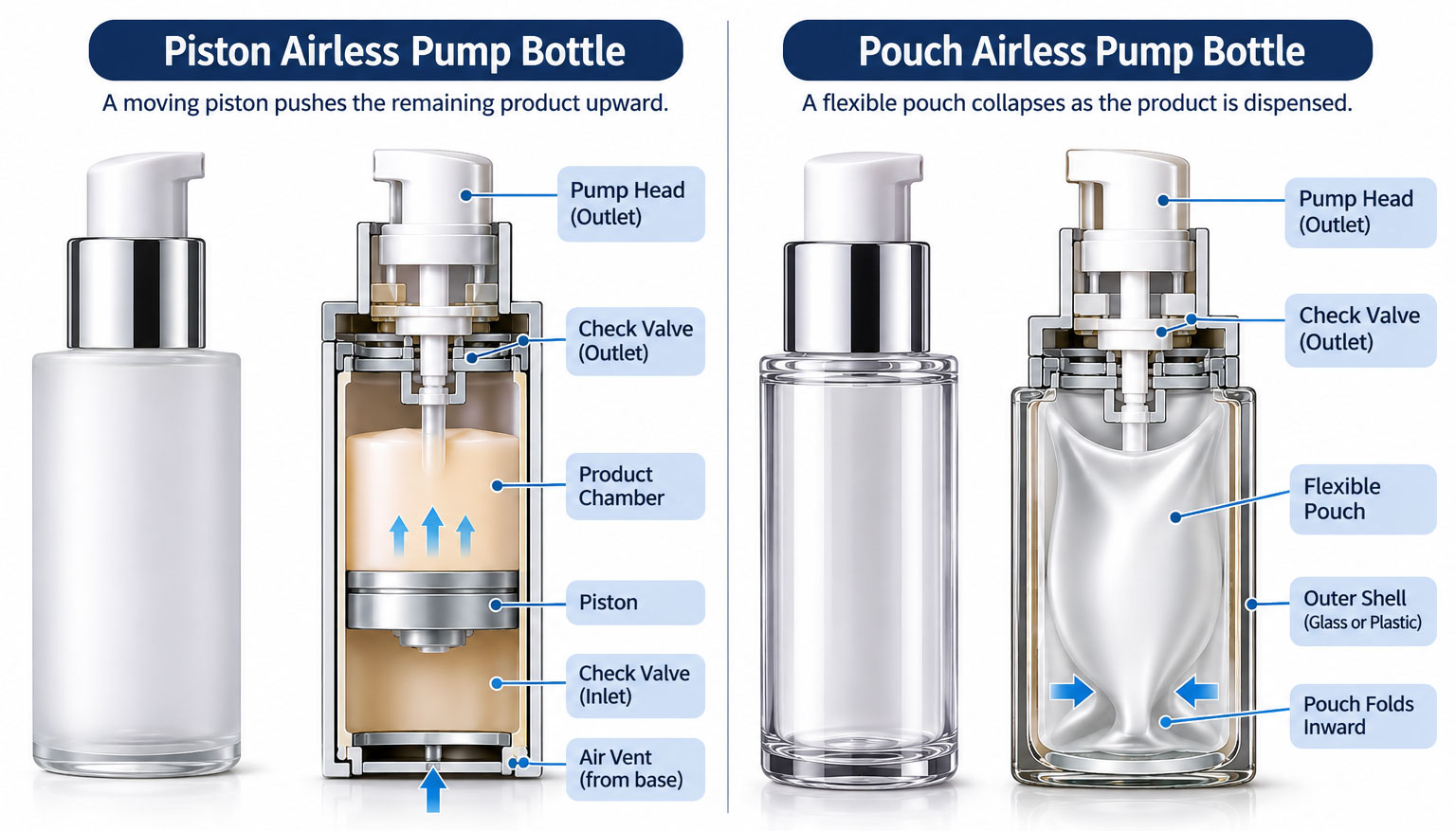
A piston airless bottle has a rigid outer container and a movable piston positioned at the bottom. The skincare formula sits above the piston.
Each time the product is dispensed, the piston gradually moves upward, following the remaining formula.
One advantage of this design is its relatively straightforward structure. It can also provide good product evacuation when the piston and bottle dimensions are properly matched.
Where does it work best?
Piston systems are commonly used for:
-Face creams and moisturizing lotions
-Medium to thick serums
-Gels and certain foundations
-Sunscreen formulations, subject to compatibility and dispensing tests
They are particularly useful when a brand wants controlled dispensing and a packaging structure that can accommodate different formula viscosities.
What should you pay attention to?
The inner diameter and dimensional consistency of the bottle are important. If the inner wall is uneven or the piston does not fit properly, it may tilt, stick, or allow product to bypass the sealing edge.
Material selection also matters. The piston must be compatible with the ingredients in the formula, especially when the product contains oils, solvents, or other potentially reactive components.
A pouch airless system uses a flexible inner bag placed inside a rigid outer container. The formula is stored in the pouch rather than directly inside the outer bottle.
As the pump dispenses the product, the pouch gradually collapses inward.
This design allows the outer container to serve mainly as a protective and decorative shell. It can therefore offer more flexibility in packaging appearance, including the use of glass, plastic, or aluminum outer components, depending on the system design.
Where does it work best?
Pouch systems are often considered for:
-Facial essences and toners
-Micellar water
-Lightweight serums
-Other low to medium viscosity skincare formulas
They can be especially attractive for brands that want a premium glass exterior without making the glass bottle itself the product-contact chamber.
What should you pay attention to?
Pouch systems generally involve more components and can have higher packaging and filling costs.
Filling also requires careful control. If too much air remains trapped inside the pouch, it may affect dispensing consistency.
Another consideration is recycling. A flexible multilayer pouch combined with a rigid outer container can make material separation more difficult than with certain mono-material packaging designs.
| Comparison | Piston System | Pouch System |
| Internal structure | Movable piston | Flexible inner pouch |
| Product storage | Inside the outer bottle,above the piston | Inside the flexible Pouch |
| Suitable formulas | Meduim to high viscosity,depending on pump design | Low to medium viscosity, depending on pouch and pump |
| Outer packaging | Functional container | Can serve mainly as a decorative shell |
| Functional container | Generally good with proper piston fit | Depends on pouch design and filling |
| Main consideration | Dimensional tolerance and piston compatibility | Filling control and material separation |
There are also airless tubes and airless dropper-style packaging options. While their appearance and dispensing components may differ, they are based on the same general principle: limiting the formula's exposure to outside air during use.
Why Do Skincare Brands Choose Airless Packaging?
Airless packaging is not just about appearance. Its real value comes from how it handles the formula during everyday use.
Here are some of the reasons skincare brands choose this type of packaging.
Better protection for air-sensitive ingredients
Some skincare ingredients are more vulnerable to oxidation than others. Vitamin C derivatives, retinoids, certain peptides, and botanical extracts may require additional protection depending on their specific formulation.
By reducing repeated air exchange and limiting the amount of air in contact with the formula, an airless system can help support product stability.
Of course, packaging alone cannot guarantee a longer shelf life. The formula, preservatives, storage conditions, and packaging materials all play a role.
More controlled product dispensing
An airless pump delivers a measured amount of product with each stroke. This makes it easier for consumers to maintain a consistent skincare routine.
For premium formulas containing expensive active ingredients, controlled dispensing can also help reduce unnecessary product waste.
Less product left inside the container
One common frustration with traditional bottles is that some product remains at the bottom even when the pump can no longer reach it.
In a well-designed piston airless bottle, the piston moves upward as the formula is used, helping push the remaining product toward the pump.
Actual product evacuation depends on the bottle design, formula viscosity, and pump structure.
Suitable for different skincare textures
From lightweight serums to thicker creams, airless systems are available in different configurations to accommodate a range of product viscosities.
The important thing is to match the pump, internal structure, and dispensing dosage to the actual formula rather than choosing packaging based on appearance alone.
A more convenient user experience
Airless bottles can dispense product from different angles and are generally less dependent on gravity than conventional bottles.
For consumers, that means easier application, less mess, and a more controlled experience.
A premium packaging appearance
Airless packaging is widely used in premium skincare lines. Combined with a glass outer bottle, matte finishes, custom colors, or metallic decoration, it can create a clean and sophisticated look.
For brands positioning themselves in the mid-to-high-end skincare market, packaging design can be an important part of the overall product experience.
What Are the Limitations of Airless Pump Bottles?
Airless packaging has clear advantages, but it isn't the perfect solution for every product.
Before choosing one, brands should consider a few practical points.
Higher packaging costs
Compared with a standard lotion pump, an airless system usually contains more components, including additional valves, an internal piston or pouch, and a more complex pump assembly.
This can increase unit costs, particularly for customized designs or small production runs.
More demanding filling requirements
Airless packaging needs a filling process that matches its internal structure.
The formula may need to be de-aerated before filling, and the filling equipment must be suitable for the selected system. Air trapped inside the product chamber can lead to inconsistent dispensing or difficulty priming the pump.
Formula compatibility needs to be checked
Not every formula works equally well with every airless pump.
Viscosity, particle size, ingredient compatibility, and dispensing requirements should all be evaluated.
For example, mineral sunscreen formulas containing zinc oxide or titanium dioxide need particular attention to particle dispersion and pump passage dimensions.
A formula that works well in a wide-mouth jar may not necessarily work in a narrow airless pump.
Very thin formulas may need a different configuration
Water-like formulas can behave differently in piston systems, especially when the pump and valve structure are not designed for low-viscosity products.
The risk of leakage, inconsistent dosing, or poor dispensing performance needs to be evaluated during testing.
Recycling can be more complicated
Some airless bottles combine several different materials, making recycling more difficult.
Pouch systems can present additional challenges because of their multilayer construction. If sustainability is a priority for your brand, consider the full packaging structure and available recycling options before making a decision.
FAQ
Why does my airless bottle sometimes stop pumping?
Usually one of four things: an air pocket from filling, a formula that is too viscous for the pump's intake, a bottle wall that has deformed and jammed the piston, or a piston that has tilted. Priming the pump properly after filling prevents most cases.
Can airless bottles be refilled?
Some newer designs use replaceable cartridges, which is a growing category. Most standard airless packs, however, are single-use by design.
Are airless bottles suitable for sunscreen?
Yes, certain airless systems can be used for sunscreen products, including mineral sunscreen formulations.However, the pump and valve structure must be suitable for the formula's viscosity and particle characteristics. Compatibility, dispensing consistency, and product stability should be verified before mass production.
How accurate is the dosage of an airless pump?
The amount dispensed per stroke depends on the pump specification and formula characteristics.Some pumps are designed to deliver approximately 0.15–0.50 ml per stroke. However, actual output can vary with viscosity, temperature, pump design, and filling conditions.For this reason, dosage accuracy should be confirmed through repeated dispensing tests using the actual formula.
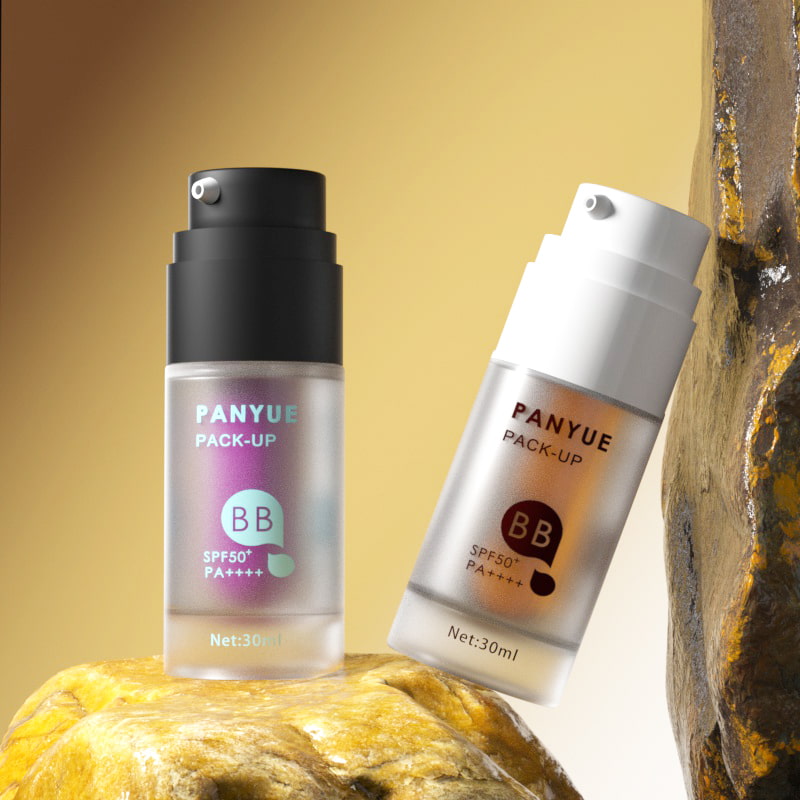
At Panyue Packing, we offer glass and plastic skincare packaging solutions for different product applications. Whether you are developing a new serum, lotion, or cream, selecting the right bottle structure and pump system is an important part of getting your packaging right.
Looking for an airless pump bottle for your skincare brand? Contact Panyue Packing to discuss your packaging requirements and explore suitable options for your next project.